July 12 • Enrico Fermi
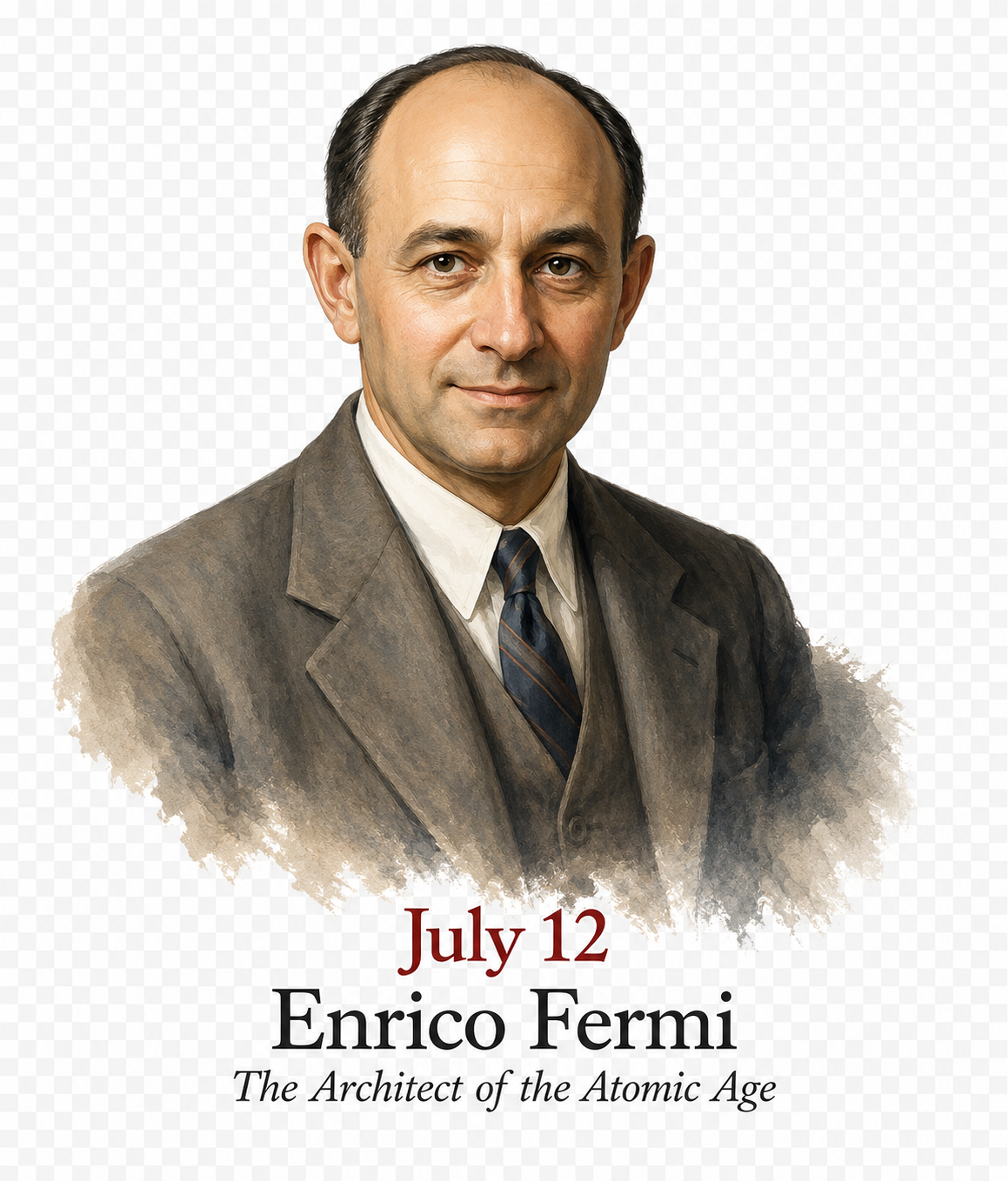
Father of the Atomic Age
Born in Rome, Italy, in 1901, Enrico Fermi was one of the most brilliant physicists of the twentieth century. His groundbreaking work in theoretical and experimental physics transformed humanity’s understanding of the atom and laid the scientific foundation for the modern nuclear age.
After receiving the Nobel Prize in Physics in 1938 for his pioneering research on neutron bombardment and induced radioactivity, Fermi emigrated to the United States. There, he became a leading scientist on the Manhattan Project and directed the team that achieved the world’s first controlled, self-sustaining nuclear chain reaction beneath the stands of Stagg Field at the University of Chicago on December 2, 1942.
Beyond his wartime contributions, Fermi’s discoveries advanced medicine, scientific research, electric power generation, and our understanding of the universe. His remarkable ability to combine theory with practical experimentation made him one of history’s most influential scientists.
Today, Enrico Fermi is remembered as the Father of the Atomic Age, a Nobel laureate whose legacy continues to shape physics, engineering, and technology around the world. His achievements stand as a lasting testament to Italian ingenuity, curiosity, and scientific excellence.