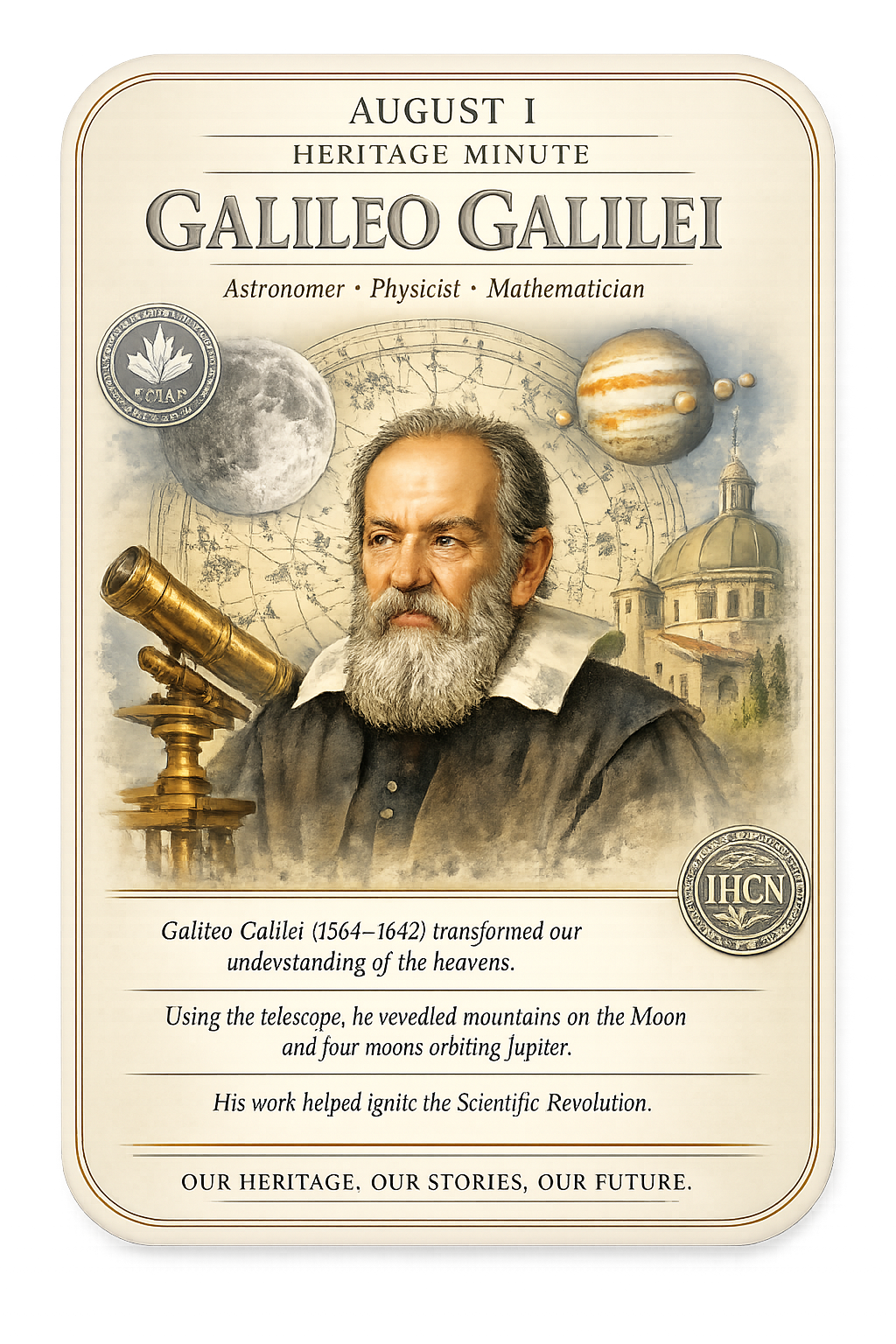
August 1 • Galileo Galilei
The Father of Modern Science
Galileo Galilei was born in Pisa in 1564 and became one of history’s most influential astronomers, physicists, and mathematicians. Guided by observation rather than inherited belief, he helped establish the experimental approach that would shape modern science.
Galileo did not invent the telescope, but he greatly improved its design and turned it toward the night sky. Through it, he observed mountains and craters on the Moon, sunspots on the Sun, the phases of Venus, and four moons orbiting Jupiter. These discoveries demonstrated that the heavens were not perfect and unchanging—and that not everything revolved around the Earth. His findings offered powerful support for the Sun-centered model advanced by Nicolaus Copernicus.
He also studied falling bodies, motion, and acceleration, helping lay the foundations of modern physics. Galileo’s defense of heliocentrism brought him into conflict with Church authorities, and in 1633 he was placed under house arrest. Yet he continued writing and investigating the laws of nature.
Galileo died in 1642, but his courage, curiosity, and insistence on evidence helped ignite the Scientific Revolution. By teaching humanity to look, measure, question, and test, Galileo transformed not only our understanding of the universe—but the very way knowledge is discovered.