
Polenta con Funghi
Key Ingredients
The northern essentials • creamy polenta and woodland mushrooms


Northern Italian Comfort in a Bowl
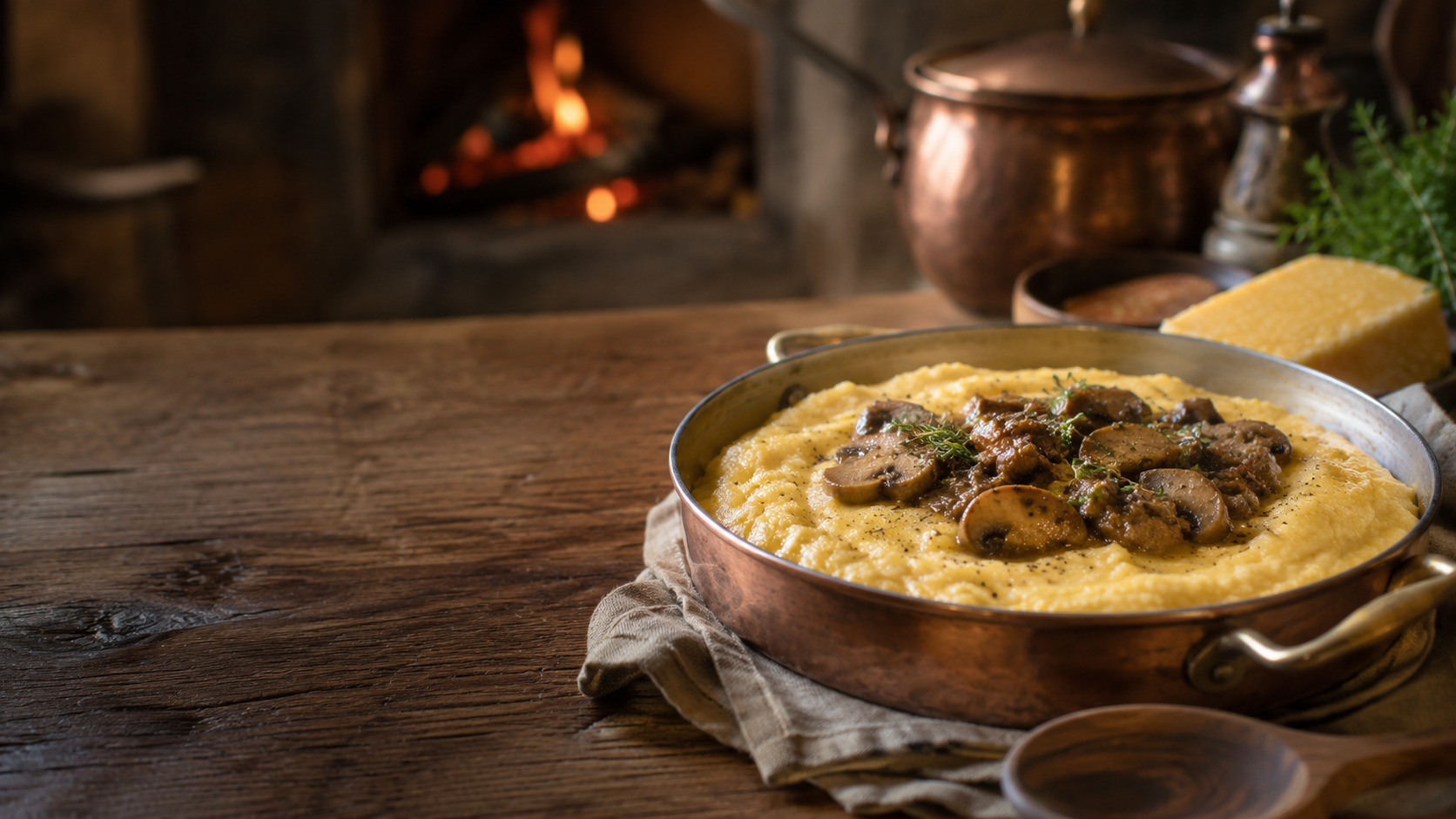
Polenta con Funghi pairs soft, golden polenta with mushrooms cooked until deeply browned and aromatic. Dried porcini intensify the flavor, while butter and Parmigiano-Reggiano give the polenta a smooth, generous finish.
A Warming Tradition of Northern Italy
Polenta has long been a foundation of cooking across northern Italy, where cornmeal is slowly transformed into a filling dish that can be served soft, cooled and sliced, or paired with meat, cheese, and vegetables. Mushrooms are a natural companion, especially in the alpine and foothill regions where porcini and other woodland varieties are prized. This version keeps the pairing direct: creamy polenta beneath a richly browned mushroom topping scented with garlic and parsley.
Ingredients
For the Polenta
- 320 g / about 2 cups coarse yellow polenta cornmeal Use traditional, non-instant polenta for the fullest flavor and texture.
- 1.5 liters / about 6⅓ cups water
- 1½ teaspoons fine sea salt
- 30 g / 2 tablespoons unsalted butter
- 70 g / about ¾ cup finely grated Parmigiano-Reggiano
For the Mushrooms
- 30 g / about 1 ounce dried porcini mushrooms
- 500 g / about 1 pound mixed fresh mushrooms Cremini, oyster, shiitake, chanterelle, or fresh porcini may be combined.
- 2 tablespoons extra-virgin olive oil
- 15 g / 1 tablespoon unsalted butter
- 2 garlic cloves, lightly crushed
- 2 tablespoons finely chopped flat-leaf parsley, plus more for serving
- ½ teaspoon fine sea salt, plus more as needed
- Freshly ground black pepper
- Warm water or light vegetable broth, as needed
For Serving
- Additional finely grated Parmigiano-Reggiano
- Extra-virgin olive oil, optional
Preparation
- Rehydrate the porcini. Place the dried porcini in a bowl and cover with about 1 cup of warm water. Let them stand for 20 minutes. Lift them from the liquid, rinse briefly to remove grit, squeeze gently, and chop. Strain the soaking liquid through a coffee filter or several layers of cheesecloth and reserve it.
- Begin the polenta. Bring the water and 1½ teaspoons salt to a boil in a heavy saucepan. Reduce to a steady simmer and pour in the cornmeal in a thin stream while whisking continuously.
- Cook slowly. Switch to a sturdy wooden spoon. Cook over low heat for 45–50 minutes, stirring frequently and scraping the bottom and corners. The polenta should become tender, creamy, and pull slightly from the sides of the pan.
- Prepare the fresh mushrooms. While the polenta cooks, clean the fresh mushrooms with a brush or lightly damp towel. Trim the stems as needed and cut the mushrooms into substantial slices or pieces.
- Brown in batches. Heat the olive oil in a wide skillet over medium-high heat. Add the crushed garlic. Cook the fresh mushrooms in two or three batches so the pan does not become crowded. Let each batch brown before stirring frequently.
- Add the porcini. Return all fresh mushrooms to the skillet and add the chopped porcini. Pour in ¼ cup of the strained porcini liquid and simmer until the mushrooms are tender and the liquid has reduced to a glossy coating.
- Finish the mushrooms. Season with salt and black pepper. Remove the garlic cloves, stir in the tablespoon of butter and chopped parsley, and take the pan off the heat.
- Finish the polenta. Remove the cooked polenta from the heat and stir in the butter and Parmigiano-Reggiano. When the polenta is too firm to flow softly from the spoon, loosen it with a little hot water or broth.
- Assemble the dish. Spoon the hot polenta into warm shallow bowls or onto a serving platter. Create a shallow well in the center and add the mushrooms with their pan juices.
- Serve immediately. Finish with Parmigiano-Reggiano, parsley, black pepper, and a small drizzle of olive oil when desired. Serve while the polenta remains soft and flowing.
Patience Creates the Creamiest Polenta
Use Traditional Cornmeal
Instant polenta is convenient, but long-cooking cornmeal develops a fuller corn flavor and a more satisfying texture.
Add Cornmeal Gradually
A slow, steady stream and continuous whisking during the first minutes prevent lumps before the polenta begins to thicken.
Do Not Crowd Mushrooms
Mushrooms release moisture when crowded. Cooking in batches allows them to brown rather than steam.
Strain Porcini Liquid Carefully
The soaking liquid contains tremendous flavor but often carries fine grit. Filter it thoroughly before adding any portion to the skillet.
Keep Polenta Soft
Polenta thickens quickly as it rests. Hold back a little hot water or broth so the texture can be loosened immediately before serving.
Leftovers Become a New Dish
Spread extra polenta in a shallow pan and chill. Once firm, cut it into slices and grill, bake, or pan-fry until crisp.
Find Ingredients and Vendors in Your Area
This recipe page is prepared for a future connection to participating Italian markets, specialty-food retailers, local ingredient sources, and COIAF Marketplace listings. The sourcing feature will be activated when the retailer and vendor program is ready.
Cultural and Culinary References
- La Cucina Italiana: Polenta with Mushroom Ragù
- La Cucina Italiana: How to Make Polenta
- La Cucina Italiana: Polenta and Northern Italian Tradition
- Ingredient photography: polenta cornmeal by Popo le Chien, licensed under CC BY-SA 3.0; porcini mushrooms by Vander01, licensed under CC BY-SA 4.0; butter by The Digital Pimp, licensed under CC BY 2.0; and Parmigiano-Reggiano by Jon Sullivan, released into the public domain. The photographs are embedded for reliable display.
This COIAF home-kitchen adaptation presents a vegetarian Polenta con Funghi built on slow-cooked yellow cornmeal and deeply browned porcini and mixed mushrooms. Northern Italian household versions vary widely and may use different local mushrooms, cheeses, herbs, meat sauces, or regional styles of polenta.