
Parmigiana di Melanzane
Key Ingredients
The Southern Italian essentials • eggplant, tomato, cheese, and basil


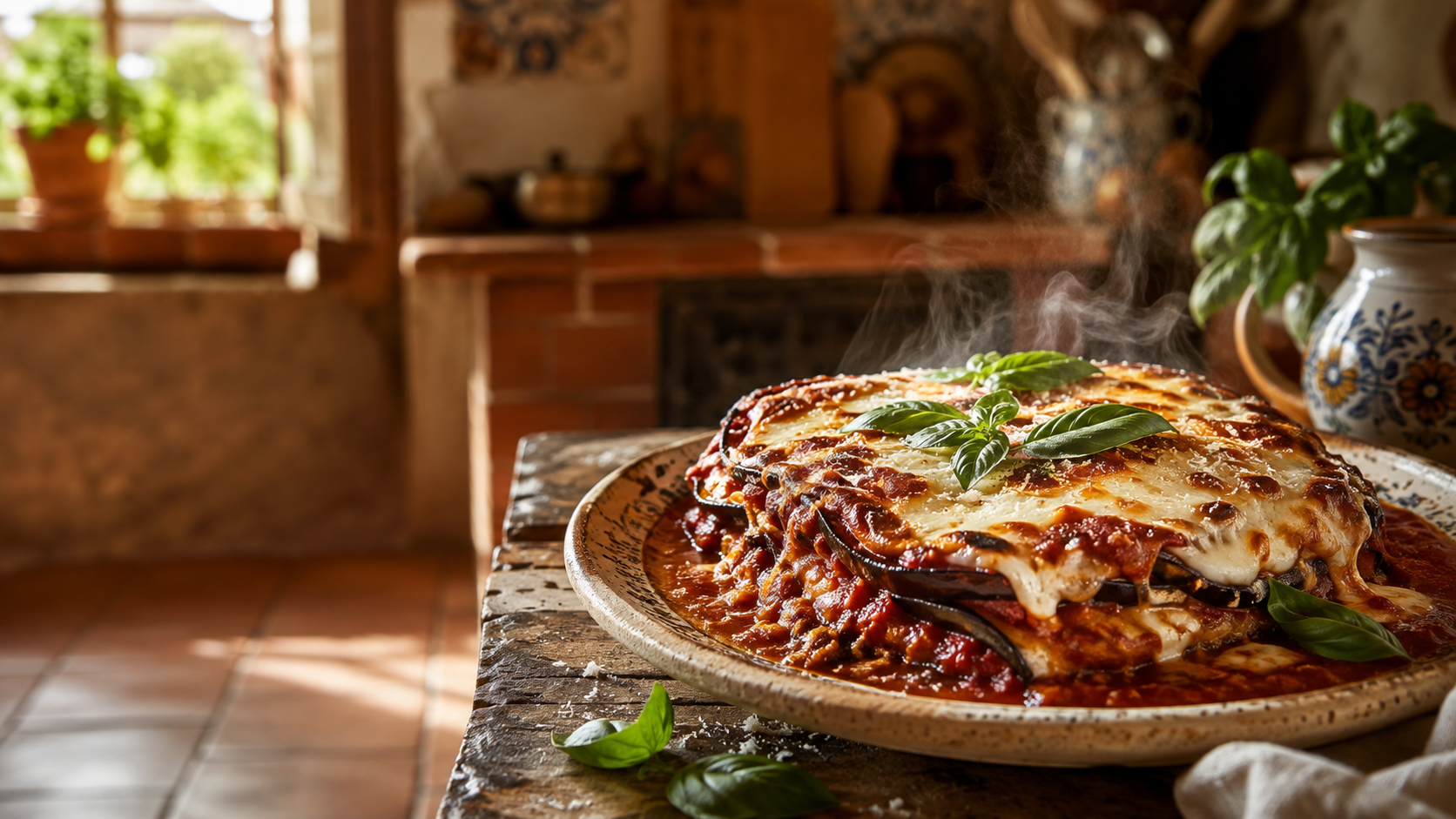
One of Southern Italy’s Great Layered Dishes
Parmigiana di Melanzane combines tender fried eggplant with tomato sauce, fresh mozzarella, Parmigiano-Reggiano, and basil. Baking unites the layers, while a generous resting period transforms the dish from bubbling casserole into a sliceable, deeply flavored centerpiece.
A Beloved Dish with Several Claims of Origin
Parmigiana di Melanzane is firmly rooted in southern Italian cooking, but its precise birthplace remains debated. Sicily points to the island’s long history with eggplant and the possible connection between the layered slices and the Sicilian word parmiciana, referring to overlapping wooden shutter slats. Campania points to early Neapolitan culinary writing and its own tradition of pairing eggplant with tomato and mozzarella. Whatever its origin, the dish’s enduring foundation is unmistakable: eggplant, tomato, mozzarella, aged cheese, and basil arranged in repeated layers.
Ingredients
For the Eggplant
- 1.3 kg / about 3 pounds firm eggplants
- Coarse sea salt, for draining
- ½ cup all-purpose flour, for a very light coating
- Peanut or sunflower oil, for frying
For the Tomato Sauce
- 700 g / about 3 cups tomato passata or smooth tomato purée
- 1 small onion, finely chopped, or 2 lightly crushed garlic cloves
- 2–3 tablespoons extra-virgin olive oil
- Fine sea salt
- Freshly ground black pepper
For the Layers
- 500 g / about 1 pound fresh mozzarella, diced or thinly sliced and thoroughly drained
- 80 g / about ¾ cup finely grated Parmigiano-Reggiano
- 20–24 fresh basil leaves
Preparation
- Slice the eggplant. Trim the eggplants and cut them lengthwise or into rounds approximately ⅕ inch / 5 millimeters thick. Keep the slices uniform so they fry and bake evenly.
- Salt and drain. Arrange the slices in a colander, sprinkling each layer lightly with coarse salt. Place a plate and light weight on top and leave them for 1–2 hours so excess vegetation water drains away.
- Prepare the tomato sauce. Heat the extra-virgin olive oil in a saucepan. Soften the onion or garlic gently, add the tomato passata and salt, and simmer uncovered for approximately 20 minutes, until the sauce is flavorful and no longer watery. Remove whole garlic cloves.
- Drain the mozzarella. Cut the mozzarella and place it in a strainer while the eggplant drains. Pat it gently with absorbent paper before assembling the dish.
- Dry and flour the eggplant. Rinse excess surface salt only when necessary, then pat every slice completely dry. Dust with flour and shake away all visible excess. This is not a breadcrumb coating.
- Fry until golden. Heat approximately 1 inch of frying oil to 350°F / 175°C. Fry the eggplant in small batches until golden and tender on both sides. Drain thoroughly on absorbent paper.
- Prepare the baking dish. Heat the oven to 350°F / 180°C. Spread a thin layer of tomato sauce across the bottom of an approximately 8-by-10-inch / 20-by-25-centimeter baking dish.
- Build the layers. Arrange a layer of fried eggplant, overlapping the slices slightly. Add tomato sauce, mozzarella, Parmigiano-Reggiano, and torn basil. Repeat until the ingredients are used.
- Finish the surface. Cover the final eggplant layer with tomato sauce and a generous coating of Parmigiano-Reggiano. Add only a restrained amount of mozzarella on top so the surface can brown.
- Bake and rest. Bake for approximately 30 minutes, until bubbling and set. Rest for at least 30 minutes before slicing. The parmigiana may be served warm or at room temperature and is often even more harmonious the following day.
The Layers Must Be Rich—Not Watery
Drain the Mozzarella Well
Wet mozzarella is one of the main causes of loose parmigiana. Cut and drain it well before the eggplant is fried.
No Breadcrumb Coating
Traditional Italian versions fry the eggplant plain or with only a light flour dusting. American-style breadcrumb crust creates a different dish.
Fry in Small Batches
Crowding lowers the oil temperature and makes the eggplant absorb more fat. Maintain steady heat and allow the oil to recover between batches.
Keep the Sauce Thick
A loose tomato sauce releases water during baking. Simmer it until concentrated enough to coat the back of a spoon.
Rest Before Cutting
The resting period is part of the recipe. It allows melted cheese, tomato, and eggplant juices to settle into defined layers.
Excellent the Next Day
Parmigiana may be baked a day ahead and reheated gently, or served at room temperature after the flavors have fully developed.
Find Ingredients and Vendors in Your Area
This recipe page is prepared for a future connection to participating Italian markets, local farms, cheese producers, specialty-food retailers, and COIAF Marketplace listings. The sourcing feature will be activated when the retailer and vendor program is ready.
Cultural and Culinary References
- La Cucina Italiana: Eggplant Parmesan: The Traditional Recipe
- La Cucina Italiana: Classic Eggplant Parmigiana Recipe
- La Cucina Italiana: History and Competing Regional Origins
- Accademia Italiana della Cucina: Campania Regional Recipe Collection
- Ingredient photography: eggplants by Leon Brooks, public domain; ripe tomatoes by Geems04, licensed under CC BY-SA 4.0; fresh mozzarella by kawu, public domain; and Parmigiano-Reggiano by Jon Sullivan, public domain. The photographs are cropped and embedded for reliable display.
This COIAF home-kitchen adaptation follows the shared Southern Italian foundation documented in classic recipes: fried eggplant, concentrated tomato sauce, mozzarella, aged grated cheese, and basil. Sicily and Campania both maintain strong historical claims, and household variations may use tuma, caciocavallo, pecorino, egg, flour, or different tomato and frying methods.