
Ossobuco alla Milanese
Key Ingredients
The Milanese essentials • marrow, braise, and gremolata


Milan’s Tender, Marrow-Rich Classic
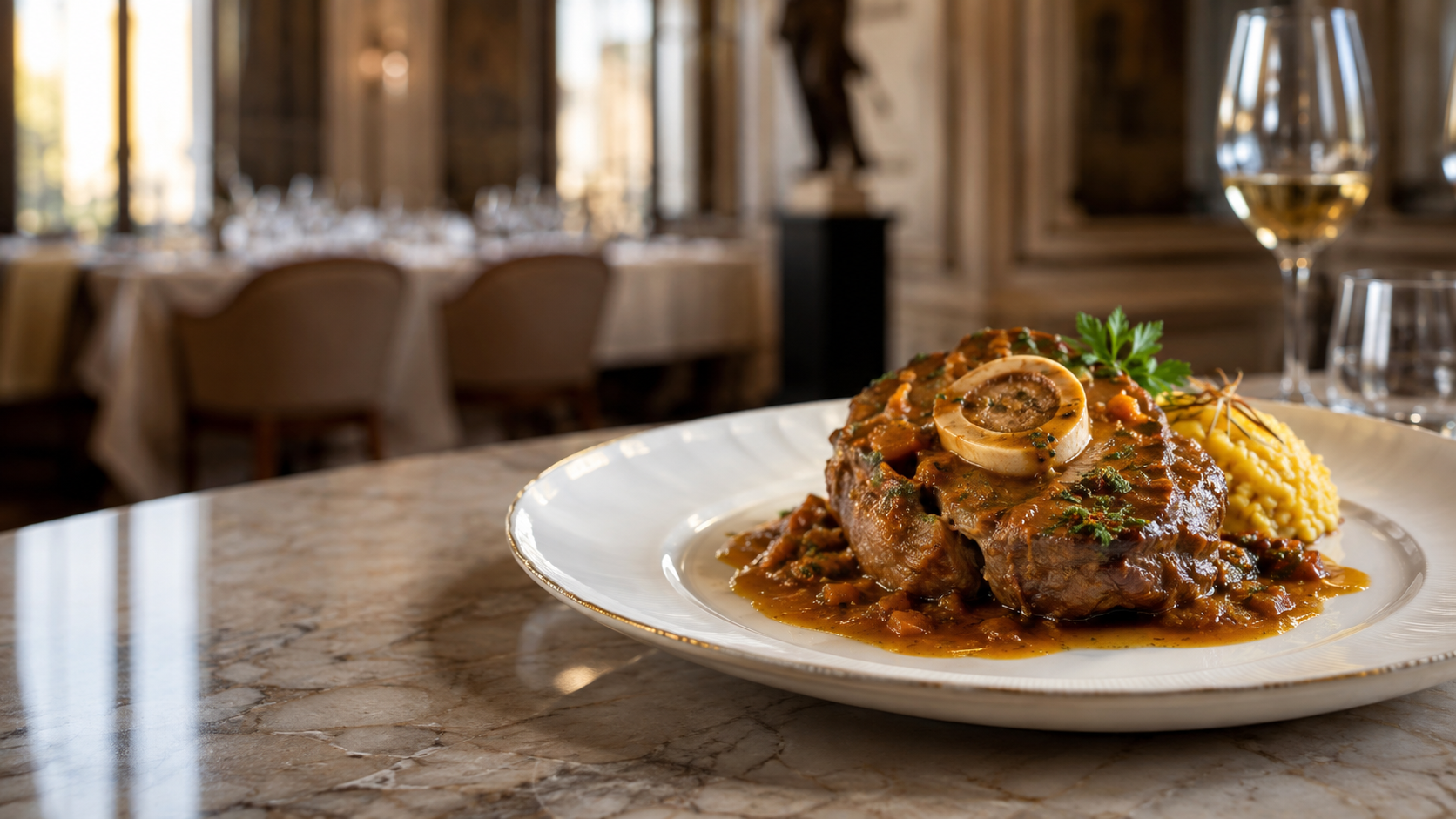
Ossobuco alla Milanese transforms cross-cut veal shanks into fork-tender meat through slow, patient braising. The marrow enriches the sauce from within the bone, while a final gremolata of parsley, garlic, and lemon brings freshness to every bite.
The “Bone with a Hole” of Milan
The name comes from the Milanese expression oss bus, meaning “bone with a hole,” a reference to the marrow-filled center of the cross-cut veal shank. Milan’s official tourism authority identifies ossobuco as a defining local dish and notes that recipes appeared in cookbooks by the eighteenth century. The traditional preparation lightly flours and browns the meat, then braises it slowly until it nearly releases from the bone. Gremolata—parsley, garlic, and lemon zest—is added at the end, and Risotto alla Milanese remains its most celebrated accompaniment.
Ingredients
For the Ossobuco
- 4 large veal shanks, each 1¼–1½ inches / 3–4 cm thick Hind-shank cuts generally offer more meat and fewer heavy tendons.
- ¼ cup all-purpose flour, for a very light coating
- 50 g / about ⅓ cup celery, very finely diced
- 50 g / about ⅓ cup carrot, very finely diced
- 50 g / about ⅓ cup onion, very finely diced
- 3 tablespoons extra-virgin olive oil
- 60 g / 4 tablespoons unsalted butter
- 240 ml / 1 cup dry white wine
- 3 tablespoons tomato passata Optional; some traditional formulas use a small quantity, while white versions omit it.
- 2–3 cups hot light meat broth, as needed
- 2 fresh sage leaves
- 1 small rosemary sprig
- Fine sea salt and freshly ground black pepper
For the Gremolata
- 2 tablespoons finely chopped flat-leaf parsley
- 1 small garlic clove, minced extremely finely
- Finely grated zest of 1 small unwaxed lemon
Traditional Accompaniment
- Freshly prepared Risotto alla Milanese
Preparation
- Prepare the veal shanks. Pat the ossobuchi dry. With kitchen scissors, snip the outer membrane in three or four places around each piece without cutting deeply into the meat. This prevents curling. Season lightly with salt and pepper.
- Flour lightly. Dust each shank with flour and shake away every visible excess. The coating should be thin enough to assist browning without creating a heavy crust.
- Brown the ossobuchi. Heat the olive oil in a broad, heavy casserole over medium-high heat. Brown the shanks well on both sides, working in batches when necessary. Transfer them to a plate.
- Deglaze with wine. Pour the white wine into the hot pan and scrape up the browned cooking residue. Simmer until the wine is reduced by roughly half, then pour the liquid into a bowl and reserve it.
- Cook the soffritto. Lower the heat to medium-low and melt the butter in the casserole. Add the celery, carrot, and onion. Cook gently for 8–10 minutes, until soft and aromatic but not browned.
- Begin the braise. Return the veal shanks to the casserole in a single layer. Add the reduced wine, the optional passata, sage, rosemary, and enough hot broth to reach approximately halfway up the sides of the meat.
- Cook slowly. Bring the liquid just to a simmer, cover, and cook over very low heat for about 90 minutes. Turn the shanks carefully once or twice and add hot broth whenever the pan begins to dry. The meat is ready when a fork enters easily and the connective tissue has softened.
- Mix the gremolata. Immediately before serving, combine the parsley, garlic, and lemon zest. Keep the mixture fresh and dry; do not cook it in advance.
- Finish the sauce. Remove the sage and rosemary. Transfer the tender shanks briefly to a warm platter. Simmer the sauce uncovered when it needs thickening, or add a splash of broth when it is too concentrated. Adjust salt and pepper.
- Serve immediately. Return the ossobuchi to the sauce and scatter most of the gremolata over them. Plate each shank with its marrow bone intact, spoon over the sauce, and finish with the remaining gremolata. Serve beside Risotto alla Milanese.
Protect the Marrow and Respect the Braise
Choose Thick Hind Shanks
Pieces approximately 3–4 centimeters thick stay moist during the long braise. Hind shanks usually contain more meat and are less heavily sinewed than front shanks.
Snip the Outer Membrane
Several shallow cuts around the perimeter keep each shank flat. Do not remove the surrounding connective tissue—it helps hold the meat together as it tenderizes.
Turn with Care
Once tender, the veal can separate from the bone. Use a broad spatula or two utensils rather than lifting the shanks by the exposed bone.
Keep the Braise Gentle
A hard boil toughens the meat and can force out the marrow. Maintain only a quiet simmer and add hot—not cold—broth when more liquid is needed.
Gremolata Comes Last
The parsley, garlic, and lemon are meant to remain bright and aromatic. Add them at the end rather than simmering them for the full cooking time.
The Marrow Is Part of the Dish
The rich marrow inside the center bone is traditionally eaten with a small spoon. Handle the shanks gently so it remains inside the bone until serving.
Find Ingredients and Vendors in Your Area
This recipe page is prepared for a future connection to participating Italian markets, specialty-food retailers, local ingredient sources, and COIAF Marketplace listings. The sourcing feature will be activated when the retailer and vendor program is ready.
Cultural and Culinary References
- YesMilano, official city tourism portal: Taste the Traditional Dishes of Milano: Ossobuco
- La Cucina Italiana: Ossobuco alla Milanese with Traditional Gremolata
- Accademia Italiana della Cucina: Lombardia Regional Recipe Collection
- Ingredient photography: veal shanks by Mogens Engelund, licensed under CC BY-SA 3.0; gremolata by Popo le Chien, dedicated under CC0; white wine by Basheer Tome, licensed under CC BY 2.0; and stock by Ryan Snyder, licensed under CC BY 2.0. The photographs are embedded for reliable display.
This COIAF home-kitchen adaptation preserves the defining Milanese method: thick veal shanks, light flouring, careful browning, white wine, slow braising, and a final parsley-garlic-lemon gremolata. Small amounts of tomato appear in some traditional formulas, while other respected versions remain entirely white.