
Arancini Siciliani
Key Ingredients
The Sicilian essentials • crisp outside, richly filled within


Sicily’s Golden Street-Food Treasure
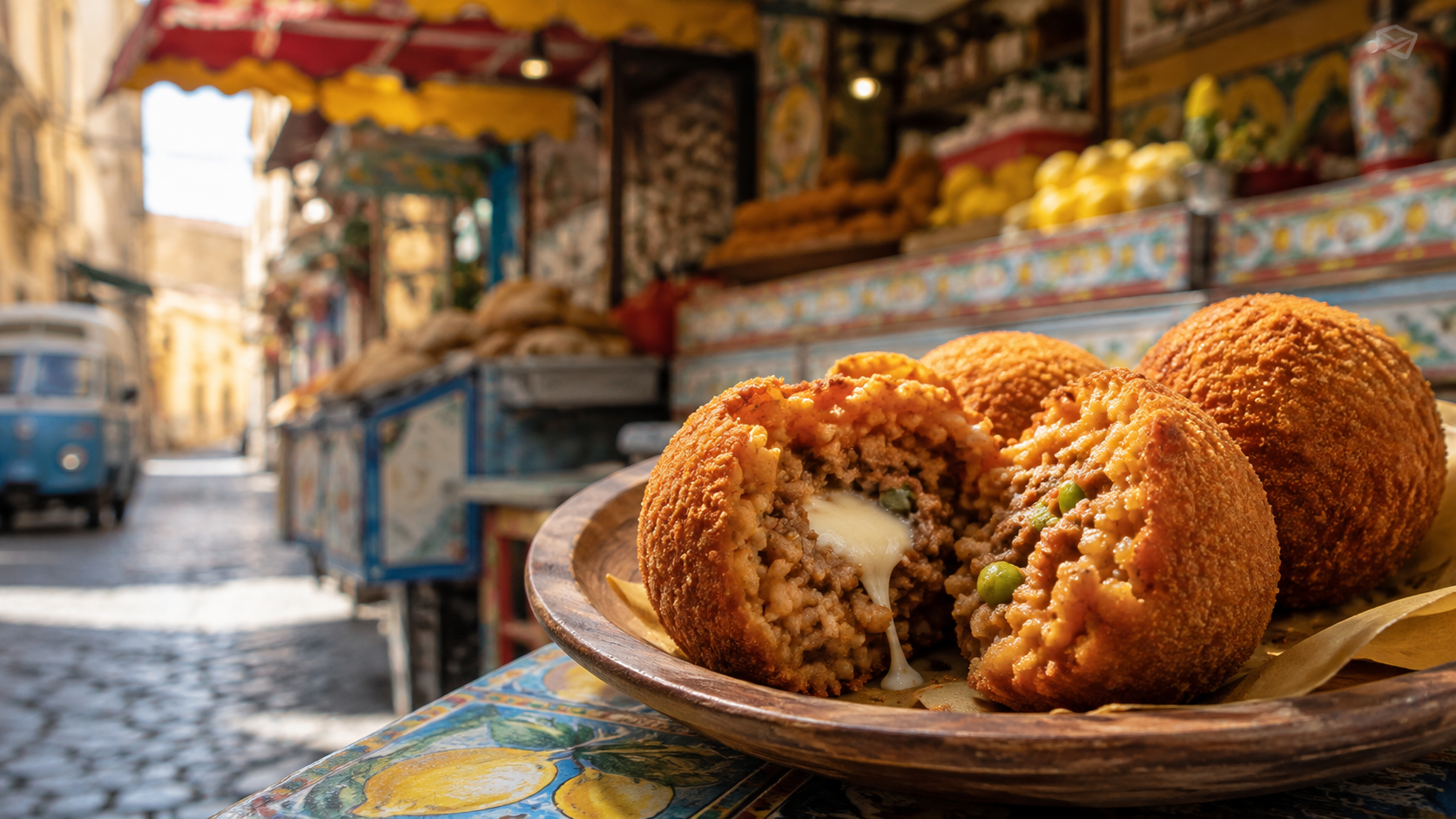
Arancini are crisp breadcrumb-coated rice parcels enclosing a deeply savory filling. This classic version combines saffron rice, thick meat ragù, green peas, and melting cheese—an unmistakable taste of Sicily served hot from cafés, bakeries, and street-food counters.
Little Oranges with a Long Sicilian History
Arancini—or arancine, depending on where one is in Sicily—are among the island’s most recognizable foods. Their name evokes small oranges because of their rounded shape and golden crust. The official Visit Sicily account describes an old, possibly Arabic-rooted tradition of saffron rice served with meat and vegetables that later became portable, individually breaded and fried portions. In western Sicily, especially around Palermo, the round form and feminine name arancina are common; in eastern Sicily, including Catania, the masculine arancino and a conical form are widely associated with the dish.
Ingredients
For the Saffron Rice
- 400 g / about 2 cups Arborio, Carnaroli, or Roma rice
- 1 quart / 950 ml lightly salted chicken or vegetable stock
- ¼ teaspoon saffron threads, lightly crushed Or one small packet of ground saffron.
- 30 g / 2 tablespoons unsalted butter
- 50 g / about ½ cup finely grated Pecorino Siciliano or Parmigiano-Reggiano
- Fine sea salt, as needed
For the Ragù Filling
- 1 tablespoon extra-virgin olive oil
- ½ small yellow onion, very finely diced
- 1 small carrot, very finely diced
- 1 small celery stalk, very finely diced
- 225 g / 8 ounces ground beef
- 80 ml / ⅓ cup dry red or white wine
- 2 tablespoons tomato paste
- 240 ml / 1 cup tomato purée
- 80 g / ½ cup green peas, fresh or frozen
- 1 bay leaf
- Fine sea salt and freshly ground black pepper
For Shaping and Frying
- 100 g / 3½ ounces low-moisture mozzarella or caciocavallo, cut into 10 small cubes
- 75 g / about ⅔ cup all-purpose flour
- 150 ml / about ⅔ cup cool water
- 250 g / about 2½ cups fine dry breadcrumbs
- Neutral frying oil, such as sunflower, canola, or peanut oil
Preparation
- Cook the saffron rice. Warm the stock with the saffron. Add the rice to a wide saucepan with the hot stock, bring to a gentle simmer, and cook until the liquid has been absorbed and the rice is tender but not mushy, about 16–18 minutes.
- Season and cool. Remove the rice from the heat and mix in the butter and grated cheese. Spread it in a thin layer on a rimmed tray. Cool completely; warm rice will be difficult to shape.
- Begin the ragù. Heat the olive oil in a saucepan over medium-low heat. Add the onion, carrot, and celery. Cook gently for 7–8 minutes, until softened but not browned.
- Brown the meat. Add the ground beef, season lightly, and cook while breaking it into very small pieces. Stir in the wine and allow it to reduce almost completely.
- Finish the filling. Add the tomato paste, tomato purée, peas, and bay leaf. Simmer uncovered for 25–30 minutes, stirring periodically, until the ragù is thick and nearly free of loose liquid. Remove the bay leaf and cool completely.
- Shape the arancini. Dampen your hands. Press about 70 g of rice into one palm to form a shallow cup. Add about 1½ tablespoons ragù and one cube of cheese. Cover with a little more rice, seal completely, and form a compact ball or gently tapered cone.
- Apply the breadcrumb coating. Whisk the flour and water into a smooth, thin batter. Dip each arancino into the batter, allow the excess to drain, and roll it thoroughly in breadcrumbs.
- Chill before frying. Arrange the coated arancini on a tray and refrigerate for 20–30 minutes. This helps the coating set and reduces the chance of splitting.
- Fry until golden. Heat 2½–3 inches of neutral oil to 350–360°F / 175–182°C. Fry two or three arancini at a time, turning as needed, for about 4–5 minutes or until evenly deep golden.
- Drain and serve. Transfer carefully to a rack or paper-lined tray. Let them rest for 5 minutes—the filling will be extremely hot—then serve while the crust is crisp and the cheese remains melted.
The Details That Keep Arancini Crisp and Intact
Cool Everything Fully
Both the rice and ragù must be cool before shaping. Warm components are softer, release steam, and make the arancini more likely to open during frying.
Keep the Ragù Thick
The filling should be spoonable but not wet. Excess sauce can soften the rice shell and weaken the seal.
Round or Conical
Both shapes belong to Sicily. Round arancine are strongly associated with Palermo; cone-shaped arancini are closely associated with eastern Sicily and Catania.
Seal the Rice Completely
No ragù or cheese should remain visible. Patch thin areas with a little extra rice before applying the batter and breadcrumbs.
Control the Oil Temperature
Oil that is too cool produces a greasy crust; oil that is too hot browns the exterior before the center is heated. A thermometer is strongly recommended.
Other Sicilian Fillings
Across Sicily, versions may feature ham and cheese, pistachio, eggplant, mushrooms, seafood, or other local combinations. Ragù with peas remains the classic starting point.
Find Ingredients and Vendors in Your Area
This recipe page is prepared for a future connection to participating Italian markets, specialty-food retailers, local ingredient sources, and COIAF Marketplace listings. The sourcing feature will be activated when the retailer and vendor program is ready.
Cultural and Culinary References
- Visit Sicily, official regional tourism portal: Arancino and Arancina
- La Cucina Italiana: Arancini al Ragù by Giusto Priola
- The Spruce Eats: Classic Sicilian Arancini
- Ingredient photography: real food photographs supplied through the Unsplash License; source photographs include meat sauce by Jennifer Pallian and mozzarella by Karolina Ferretis.
This COIAF home-kitchen adaptation follows the classic Sicilian structure of saffron rice, a thick ragù-and-pea filling, cheese, breadcrumb coating, and deep frying. Arancini recipes, names, shapes, sizes, and fillings vary throughout Sicily and among individual families.